
Buying glasses online can save you money-or leave you stuck with frames you hate and lenses that feel “off.”
With dozens of eyewear stores promising low prices, virtual try-ons, fast shipping, and premium lenses, the real challenge is knowing which claims actually matter.
Before you enter your prescription or upload a photo, it pays to compare the details that affect comfort, vision quality, returns, and total cost.
This guide shows you how to evaluate online eyewear stores like a smart buyer-not just by price, but by fit, lens options, policies, reputation, and long-term value.
What Defines a Trustworthy Online Eyewear Store Before You Buy Glasses
A trustworthy online eyewear store makes the buying process clear before you enter your payment details. Look for transparent pricing on prescription glasses, lens coatings, progressive lenses, blue light lenses, shipping costs, and vision insurance eligibility-not just a low frame price that rises at checkout.
The store should also explain how it handles your prescription. A reliable site will request your sphere, cylinder, axis, and pupillary distance, or offer a safe way to upload a prescription from your optometrist. If you are buying multifocal or high-index lenses, clear prescription verification matters even more because small measurement errors can affect comfort.
- Clear return, refund, and lens replacement policies
- Verified customer reviews on platforms like Trustpilot
- Secure checkout options such as credit card protection or PayPal
In real-world use, the best online glasses retailers make support easy when something goes wrong. For example, if your new prescription sunglasses feel blurry while driving, you should be able to contact customer service, confirm the prescription details, and request a remake or adjustment without confusing terms or hidden fees.
Also check whether the store provides practical tools such as virtual try-on, frame size filters, PD measurement guidance, and lens comparison options. These features are not just convenient; they reduce the chance of ordering frames that slide down your nose or lenses that do not match your daily screen, reading, or driving needs.
How to Compare Prescription Accuracy, Frame Fit, Lens Options, and Total Cost
Start with prescription accuracy, especially if you need progressive lenses, high-index lenses, or a strong astigmatism correction. A reliable online eyewear store should ask for your full prescription, pupillary distance (PD), and lens type, then clearly explain how it verifies the order before production. Tools like Warby Parker Virtual Try-On or a printable PD ruler can help, but for complex prescriptions, using a PD measured by an optician is usually safer.
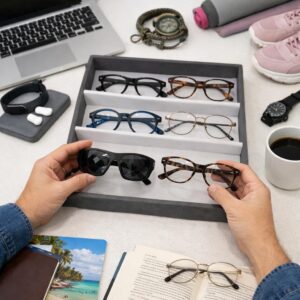
Frame fit matters just as much as lens quality. Compare the lens width, bridge width, and temple length against a pair you already own and like; for example, if your current frame says 52-18-140, stay close to those numbers when shopping online. Also check the return policy, because a frame that looks good in a virtual try-on may still slide down your nose or feel tight after an hour.
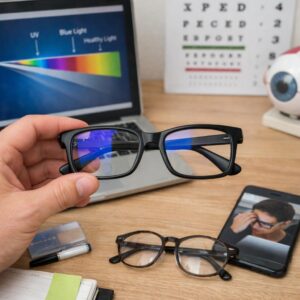
- Lens options: Look for anti-reflective coating, scratch resistance, UV protection, photochromic lenses, blue light filtering, and progressive lens upgrades.
- Total cost: Compare frame price, prescription lens cost, coatings, shipping, taxes, and any vision insurance or FSA/HSA eligibility.
- Service value: Check remake policies, adjustment support, warranty coverage, and whether customer service can review prescription issues.
The cheapest prescription glasses online are not always the best deal. A $35 frame can become expensive once you add thin lenses, premium coatings, and expedited shipping. Compare the final checkout price, not just the advertised starting price.
Common Mistakes to Avoid When Choosing an Online Glasses Retailer
One common mistake is comparing only the frame price and ignoring the total prescription glasses cost. Lens upgrades such as anti-reflective coating, high-index lenses, blue light filtering, photochromic lenses, or progressive lenses can double the final price at checkout.
Do not skip the return policy details. Some online eyewear stores offer free returns on frames but charge restocking fees or exclude custom prescription lenses, which matters if your progressive lenses feel off or the frame fit is uncomfortable.
- Check whether prescription lens replacement is allowed after purchase.
- Confirm who pays return shipping and adjustment costs.
- Look for a clear warranty on coatings, hinges, and manufacturing defects.
Another mistake is trusting virtual try-on without checking measurements. Tools like Warby Parker’s Virtual Try-On are useful, but you still need to compare lens width, bridge size, and temple length with a pair you already wear comfortably.
Be careful with retailers that do not explain prescription requirements clearly. If you need multifocal or progressive lenses, make sure they ask for accurate PD measurement and fitting height; otherwise, you may end up with glasses that look fine but cause eye strain during computer work or driving.
A real-world example: someone buying cheap online glasses for remote work may save on frames but overspend later if the lenses lack anti-glare coating for long screen sessions. Always compare the full package-frames, lenses, shipping, vision insurance eligibility, customer support, and after-sale adjustments-before choosing the cheapest option.
Expert Verdict on How to Compare Online Eyewear Stores Before Buying Glasses
Choosing an online eyewear store should come down to confidence, not just cost. The best option is the one that makes the full buying process clear: accurate prescription entry, realistic frame details, fair return terms, dependable support, and transparent final pricing.
Practical takeaway: compare stores as if you are comparing service, not only glasses. If a retailer makes policies hard to find, adds surprise fees, or offers limited help, keep looking. Buy from the store that gives you the strongest mix of value, fit assurance, and post-purchase protection.

Dr. Oliver Hartman is an optical health researcher dedicated to simplifying topics related to eyesight, eyewear, and daily vision protection for general readers. His work focuses on helping people better understand vision care, eye comfort, lens options, prescription glasses, contact lenses, and healthy habits for protecting the eyes in everyday life. Through clear and practical guidance, he aims to make eye health information easier to access, easier to understand, and more useful for daily decision-making.