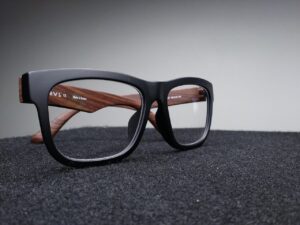
Comparing online eyewear stores is less about finding the lowest advertised price and more about reducing the chance of a poor fit, unsuitable lenses, or an expensive return. The right store should support your prescription, provide useful frame measurements, disclose the full cost, and explain what happens if the glasses do not work for you.
Start with the factors that can disqualify a store. Style, color, and promotions matter only after you know the seller can make the glasses you need and offers reasonable help when something goes wrong.
Before ordering: Use a current prescription from a qualified eye care professional. Do not estimate prescription values or rely on an online order to replace an eye exam. If your vision has changed, your prescription has expired, or you have eye symptoms, address those concerns before buying glasses.
Use a Pass-or-Pause Screen Before Comparing Frames
A polished website and a large frame selection do not tell you whether a store is a good match for your needs. Before spending time browsing, confirm these essentials:
- Prescription compatibility: The store clearly states that it can make your lens type and prescription range.
- Complete frame measurements: Product pages include more than a generic small, medium, or large label.
- Visible lens pricing: You can see how lens type, material, and coatings affect the total.
- Written return and remake terms: The policy specifically addresses prescription lenses, not only empty frames.
- Reachable customer support: The company offers a practical way to ask prescription, fit, or order questions.
- Secure checkout and clear business policies: Contact, privacy, shipping, and payment information are easy to find.
If a seller is vague about prescription limits, lens charges, or returns, pause before entering personal or payment information. A discount does not compensate for unclear terms.
Compare the Same Pair at Each Store
The price displayed beside a frame is rarely the best number for comparison. It may include only basic single-vision lenses, while your order requires progressives, a different lens material, coatings, or other options.
Build an equivalent order at each store and compare the total before payment. Keep the prescription type, frame category, lens material, coatings, shipping method, and protection options as consistent as possible.
| Item to Compare | What to Record | What Can Change the Decision |
|---|---|---|
| Frame | Material, dimensions, weight if listed, and included case | A lower-priced frame may provide fewer measurements or adjustment options |
| Prescription lenses | Single vision, bifocal, progressive, reading, or distance | Some stores or frames do not support every prescription type |
| Lens material | Standard or thinner material recommended for the prescription | Stronger prescriptions may affect thickness, weight, and frame suitability |
| Coatings and features | Anti-reflective, scratch-resistant, photochromic, tint, or other add-ons | Features included by one store may cost extra at another |
| Delivery | Shipping charge and estimated production and transit times | “Fast shipping” may not include the time required to make the lenses |
| Returns and remakes | Refund method, deadline, shipping fees, and prescription-lens eligibility | A flexible policy can be more valuable than a small initial saving |
| Final total | Complete amount after selected options, shipping, and applicable taxes | The advertised starting price may be very different from the checkout total |
A useful comparison is not “Which store has the cheapest frame?” It is “Which store offers the best combination of a suitable pair, a clear final cost, and acceptable options if the order needs correction?”
Confirm That the Store Can Handle Your Prescription
Prescription compatibility should be checked before frame style. A prescription may include sphere, cylinder, axis, add power, or prism values. Stores vary in the ranges and lens designs they accept, and not every frame can accommodate every prescription.
Look for a guided entry process that clearly separates the right and left eyes and preserves plus and minus signs. Uploading a prescription image may reduce manual entry, but review the order summary carefully. Do not guess at an unreadable value or select a “close” option.
Questions to ask when your prescription is not simple
- Does the store accept the full sphere, cylinder, axis, add, or prism values shown on the prescription?
- Are any frame sizes or shapes restricted for this prescription?
- Does the company review the order for prescription-and-frame compatibility before production?
- What measurements are required in addition to the prescription?
- What is the remedy if the glasses are made to the submitted information but do not provide usable vision?
Be particularly cautious with progressives, bifocals, prism correction, strong prescriptions, or previous difficulty adapting to new glasses. These orders may depend on precise fitting measurements and frame positioning that are easier to evaluate in person.
Treat Pupillary Distance and Fitting Measurements Seriously
Pupillary distance, commonly called PD, helps position the optical center of the lenses in relation to your eyes. It may be listed as one total measurement or separate measurements for each eye. Your prescription may not include it.
Some stores provide home-measurement tools. If you use one, follow the instructions exactly and repeat the measurement to check for consistency. A home tool is not a reason to estimate. Ask an eye care provider or optical professional for help if the result is unclear, especially for multifocal or stronger prescriptions.
Progressive lenses may require more than a basic PD. The fitting process can depend on where the pupils sit within the selected frame and how the frame rests on the face. Before ordering progressives online, find out which measurements the store uses and how they are obtained.
Use Your Current Glasses as a Fit Reference
If you already own a comfortable pair, its measurements are a better starting point than a virtual try-on image. Three numbers are often printed inside a temple arm or near the bridge:
- Lens width: the horizontal width of one lens.
- Bridge width: the space between the lenses over the nose.
- Temple length: the length of the arms extending toward and behind the ears.
Also compare the overall frame width and lens height when the store provides them. Overall width affects whether the frame pinches or slides, while lens height can be important for multifocal lens designs.
| Fit Concern | Detail to Compare | What to Keep in Mind |
|---|---|---|
| Frames slide down | Bridge design, bridge width, overall width, and frame weight | The same bridge measurement can fit differently across frame shapes and materials |
| Pressure at the temples | Overall frame width and temple design | A narrow frame may remain uncomfortable even if the temple length is correct |
| Arms feel too short or long | Temple length | Temple shape and adjustability also affect how securely the frame sits |
| Lenses appear thick | Frame size, lens shape, prescription, and lens material | Ask whether the chosen frame is appropriate for the prescription |
| Multifocal viewing areas feel limited | Lens height and fitting measurements | Not every shallow frame is suitable for every multifocal design |
Virtual try-on tools can help with color and general appearance, but they cannot guarantee bridge comfort, pressure at the temples, lens thickness, or accurate optical positioning.
Evaluate Lens Add-Ons Without Following Every Upsell
Lens upgrades should solve a specific need. Read what each feature does, whether it is included, and whether the store offers different quality levels under similar names.
- Anti-reflective coating: Reduces reflections on the lens surface. Ask whether it is included with the selected lens package.
- Scratch-resistant coating: May improve durability but does not make lenses scratch-proof.
- Thinner lens materials: May reduce bulk for some prescriptions, but suitability depends on the prescription and frame.
- Photochromic lenses: Change tint in response to light conditions. Review the seller’s description of how the specific product behaves.
- Blue-light filtering: Should be treated as an optional lens feature, not a substitute for an accurate prescription, appropriate screen habits, or professional care for persistent symptoms.
If an upgrade is described only with terms such as “premium” or “advanced,” look for a concrete explanation of the lens material, coating, warranty, and intended benefit before paying more.
Read the Return Policy as Carefully as the Product Page
Prescription eyewear is customized, so a store’s general merchandise policy may not apply. Find the section specifically covering prescription glasses and answer these questions before ordering:
- Does the return period begin on the order date, shipping date, or delivery date?
- Are prescription lenses eligible for a refund, exchange, or remake?
- Is the refund returned to the original payment method or issued as store credit?
- Are original shipping charges, upgrades, or protection plans refundable?
- Who pays to send the glasses back?
- Is the policy limited to one return or one remake?
- What documentation is required for a prescription-related concern?
- Does the warranty cover only manufacturing defects, or does it include other damage?
- Can the frame be adjusted locally without affecting return eligibility?
Keep a copy of the policy that was displayed when you ordered, along with the prescription submitted, selected measurements, order confirmation, and support messages. Policies may differ by product or change over time.
Test Customer Support Before Placing a Difficult Order
If the order involves progressives, a strong prescription, uncertain measurements, or a frame-compatibility question, contact support before paying. The usefulness of the response can reveal more than a general promise of “excellent service.”
Ask one specific question, such as:
- “Does this frame support every value on the prescription I plan to submit?”
- “Which fitting measurements do you require for progressive lenses?”
- “If the frame fits but the lenses do not provide clear vision, what does your remake policy cover?”
- “Can these glasses be adjusted by a local optical shop without voiding the return policy?”
Save the response. A fast but vague answer is less useful than a clear explanation that matches the written policy.
Check Trust Signals in Context
HTTPS and a professional-looking design are basic expectations, not proof that a seller is reliable. Review the complete picture:
- A physical business identity or clearly stated company information
- Accessible contact methods and posted support hours, when applicable
- Privacy, shipping, return, warranty, and terms pages written in understandable language
- A checkout page that clearly identifies the seller and order total
- Product pages with complete measurements and lens limitations
- Reviews that discuss prescription accuracy, fit, shipping, support, and returns rather than only frame appearance
Look for patterns across reviews instead of relying on one rating. Repeated reports of unexplained charges, missing orders, unresponsive support, or denied returns deserve attention. Reviews hosted by the seller can be useful, but independent sources may provide additional context.
Match the Store to the Risk of the Order
There is no single best online eyewear store for every buyer. The amount of support you need should influence the decision.
A simple backup pair
Someone with a current single-vision prescription, a known PD, and a familiar frame size may prioritize straightforward pricing and a reasonable return policy.
Glasses worn all day
For a primary pair, frame comfort, lens quality, support, and remake terms may deserve more weight than the lowest total. Small fit problems become more significant when glasses are worn for many hours.
Progressive or otherwise complex lenses
Measurement methods, frame suitability, professional fitting, and remake support become more important. If the online process does not adequately address those needs, an in-person optical provider may be the better option.
Prescription sunglasses
In addition to prescription and fit questions, compare tint, polarization if offered, and the seller’s description of sun protection. Do not assume that lens darkness alone explains the level of ultraviolet protection.
Inspect the Glasses Promptly After Delivery
Do not set the package aside until the return window is nearly over. Once the glasses arrive:
- Compare the order with your confirmation. Check the frame, prescription type, lens features, tint, and other selected options.
- Inspect the frame and lenses. Look for visible defects, loose components, coating problems, or shipping damage.
- Assess the fit. Notice sliding, pinching, uneven temples, pressure points, or eyelashes touching the lenses.
- Try the glasses in a safe setting. Check distance and near tasks appropriate for the prescription. Do not drive or perform hazardous work if vision is unclear.
- Contact the seller promptly. Describe the problem clearly and ask whether the next step is an adjustment, return, prescription check, or remake.
Some fit problems can be corrected by an optical adjustment, but confirm whether outside adjustments affect the store’s return policy. Do not bend or alter the frame yourself if doing so could damage it or limit your return options.
When professional care matters: Contact an eye care professional if new glasses cause persistent blurred or double vision, headaches, dizziness, significant eye strain, or difficulty performing daily activities safely. Sudden vision loss, severe eye pain, a curtain-like shadow, or new flashes and floaters should be evaluated promptly rather than handled only as a retailer return.
A Practical Final Decision
Eliminate any store that cannot clearly support your prescription, provide adequate measurements, protect your information, or explain its prescription-lens return policy. Among the remaining sellers, compare complete orders rather than advertised frame prices.
The strongest choice is usually the store that gives you a suitable frame-and-lens combination, understandable terms, an acceptable final cost, and a workable remedy if the glasses arrive damaged, fit poorly, or need to be remade. For complex prescriptions or uncertain fitting needs, professional in-person help may offer more value than online convenience.
Official References
- Federal Trade Commission — Buying Prescription Glasses or Contact Lenses: Your Rights
- Federal Trade Commission — Eyeglass Rule
- U.S. Food and Drug Administration — Guidance Document for Nonprescription Sunglasses
This article provides general educational information. It does not replace an eye exam, individualized prescription guidance, or professional optical fitting.

Eyestine Vision Editorial Team publishes consumer-focused guides about eye care, eyewear, eye-exam planning, and vision insurance. Articles are educational and are not a substitute for diagnosis or treatment by a licensed eye-care professional. Unless an article explicitly names a qualified medical reviewer, readers should not assume that it received independent clinical review.